

What the House Knows · Part 3 of 3
Hot Water Is the Load I Can't Move
In short
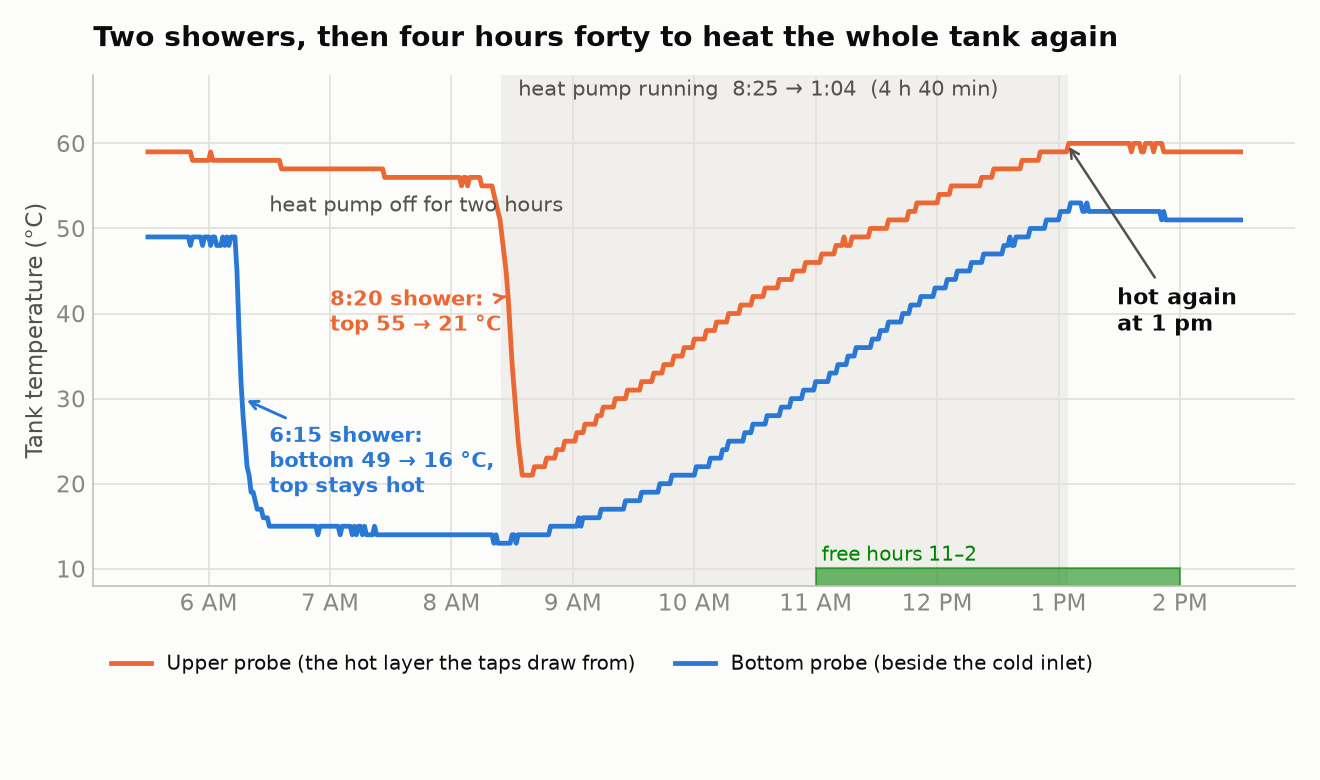
- On 13 July a 6 am shower cooled the bottom half of the tank while the top stayed hot, so the heat pump didn't start. A second shower at 8:20 took the top from 55 to 21 °C, and the heat pump then needed 4 h 40 min to heat the whole tank again.
- Of 467 hot-water draws in 99 days, two-thirds fell outside the usual shower times, so the tank has to be hot all day rather than reheated just in time.
- That is why hot water is hard to move into the free hours the way the battery can be: the showers decide when the heat is needed, and I don't.
- 4 h 40 minto heat the whole tank again after two morning showers (13 July)
- 7.5 °C an hourtypical heating rate of the tank
- 66%of 467 draws outside the usual shower times
On 13 July the hot water tank started the morning full. The overnight reheat had finished at 1 am with the top at 60 °C and the bottom at 49. At a quarter past six someone had a shower. The bottom of the tank dropped to 16 °C, but the top, the number on the unit’s display, held at 58, and the heat pump didn’t start. For two hours the tank was half cold and looked full. The 8:20 shower took the rest: in fifteen minutes the top went from 55 °C to 21. The heat pump then ran without a break from 8:25 until 1:04 in the afternoon. Four hours and forty minutes to heat a tank of cold water.
A lot of what I do with electricity at home can be moved around. Hot water is the awkward one, and that one morning shows why.
A heat pump is not a kettle
The tank holds 315 litres, with a heat pump and a backup electric element. An element is quick. A heat pump is the opposite: it moves heat from the outside air into the water, which is cheap but slow, and mine throttles itself down to do it.
I have 99 days of one-minute readings from a probe in the upper part of the tank, a probe at the bottom beside the cold inlet, and a plug that meters the power. The typical heating rate is about 7.5 °C an hour. It draws around 700 W from the wall. Efficiency is about 3.6 units of heat for every unit of electricity, so it is a good machine. It is just not a fast one.
The big reheats show what that means. There were 28 compressor runs that lifted the tank’s average by 20 °C or more. The median run took about three and a half hours, the shortest nearly two, the longest over six.
I learned how slow it was the hard way. In late July three showers in a row went tepid, and the next day the compressor ran for more than two and a half hours while the upper probe, the number on the unit’s display, fell from 59 to 44 °C. I had the warranty booklet out. The bottom probe had risen from 17 to 28 °C, though, so heat was going in at the bottom while hot water was being drawn from the top. A 99-day audit found no fault. What I had taken for a fault was just how slow the thing is.
Nobody can tell me when the showers will be
If I knew exactly when the hot water would be used, a slow heater would not matter. I would start it hours beforehand and have it finish just in time. The difficulty is that I don’t know.
This is a household of five, and a morning needs four to five hot showers. The kids’ showers do not happen on a schedule. I count a draw whenever the bottom probe drops 4 °C or more inside ten minutes, which is cold mains water rushing in. That gives 467 draws in 99 days, about 4.7 a day, covering showers, baths and taps alike.
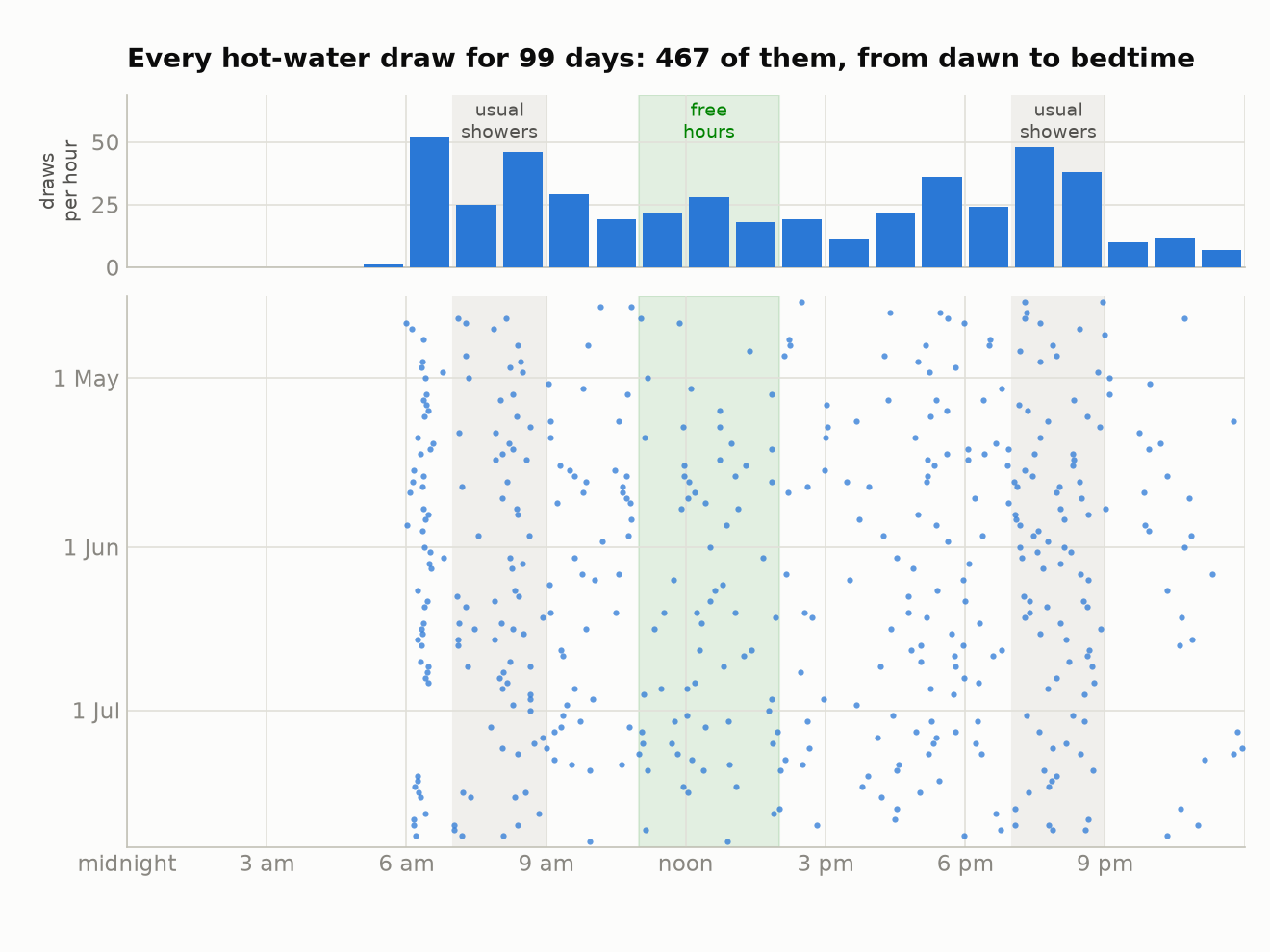
There is a draw in every hour from 6 am to 11 pm. The busiest are 6 am, 7 pm and 8 am. I had always thought of 7 to 9 in the morning and 7 to 9 in the evening as the shower windows. Two-thirds of the draws fall outside them. The busiest hour of the whole day is 6 am, before the morning window opens. That one at least is regular, a tight column of dots on many mornings. The rest are scattered right across the day.
The big reheats follow the same rhythm. Of the 28, 11 started between 7 and 10 am, just after the morning showers, and another 11 between 7 and 10:30 pm, just after the evening ones. The showers set the schedule and the heat pump follows them.
So the tank has to be hot all day
The heat pump needs hours to recover, and I can’t say when the next shower will come. The only way to make sure there is hot water at any moment is to keep the tank hot from early morning to bedtime.
I did try the other way first. My first hot-water automations were built to save money: they held the tank back around the expensive evening hours and shut the compressor off early. Over ten weeks the evening showers dropped below 45 °C on 9 of 62 evenings, and the mornings on 4 of 66. The worst evening reached only 29 °C, which is a properly cold shower. Ten of those 13 came from the compressor stopping as soon as the upper probe reached 60 °C, with the bottom of the tank still well short of hot. Even the four failed mornings began with the tank hot before dawn: the showers pulled it down 18 to 20 °C during the window, faster than anything could reheat it.
So the rule now is comfort first, then spare the battery. The tank is held at 60 °C all day, with a boost if it dips below 59 °C. There is no daily push to 70 °C: above 60 the heat pump hands over to the element, which heats only the top, and a hot top can hide a cold bottom. The one run to 70 is a weekly hygiene heat on Wednesdays. On 13 July the tank was only about half-way back when the free hours began at 11, with the upper probe at 46 °C and the bottom at 32. A free window cannot make a tank recover faster than the heat pump will go. The free hours have since moved to 12 to 3 pm, and the arithmetic is the same.
What can be moved, for contrast
The battery is the opposite case. On 25 October the house drew 50 kWh from the grid in the three free hours, filling the battery. Nobody has to be in the shower at any particular time for that to work. The dishwasher runs on a 5 am schedule and nobody notices.
The tank needs three and a half hours, and sometimes more than six, just to come back from one heavy round of showers, and the showers decide when that happens. A load that is slow and also on someone else’s timetable is about as hard to shift as it gets. I can put the battery and the dishwasher wherever it suits me, but the hot water has to be wherever the kids are.
Two thermometers, a power meter and some patience. The tank is slow, the showers are not on a schedule, and between them they decide when the house needs heat.